I build models that predict how people behave, and the evaluations that show how much to trust those predictions.
I graduated from Harvard in 2026 and studied Applied Mathematics with a focus in Economics and Computer Science. I did quantitative research at Vatic Labs, where I built trading strategies with reinforcement learning, and before that developed machine-learning models for battery and materials-science clients at SandboxAQ. Since 2024, most of my research has been on simulating people with language models.
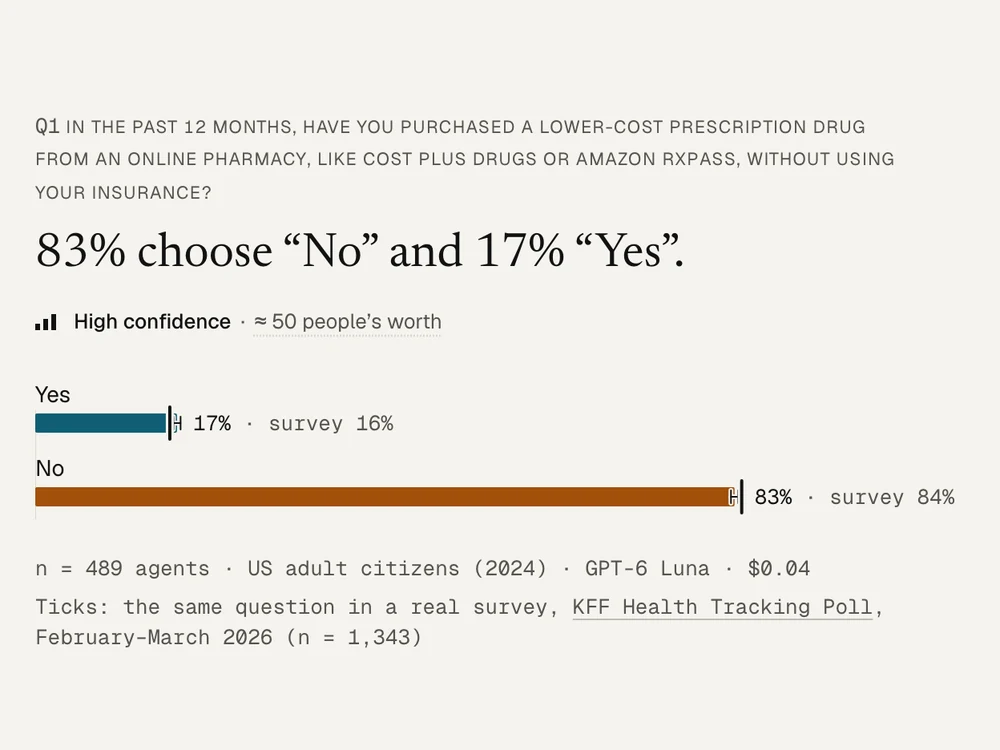
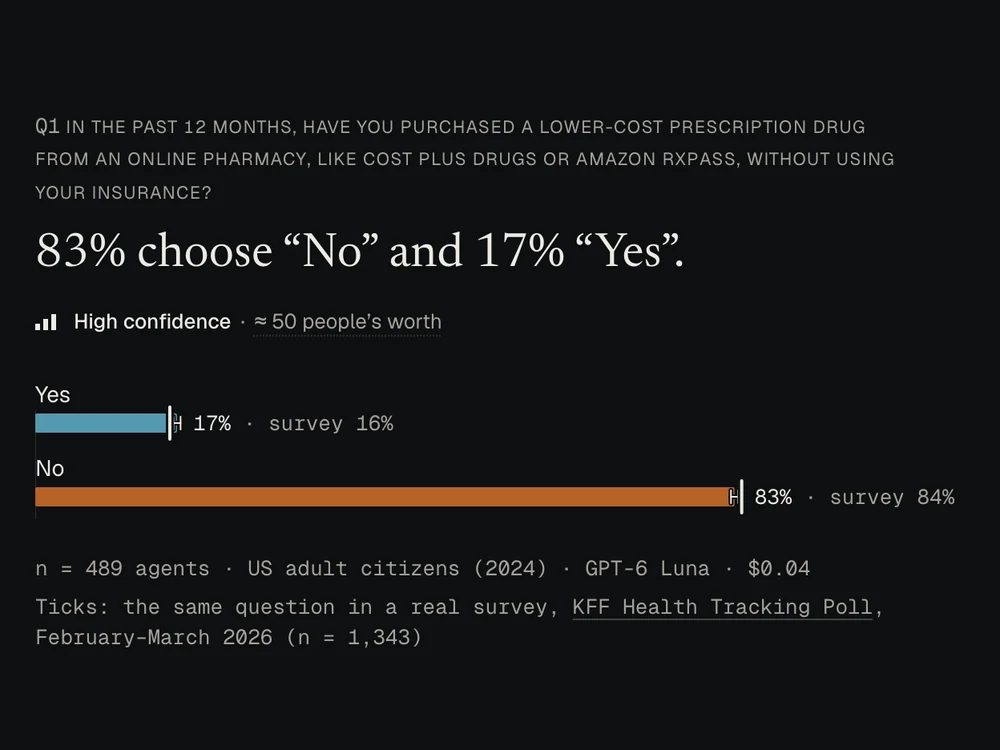
Ask a question and get simulated answers from 55,330 agents. Each agent is built from a real person in the 2024 Cooperative Election Study. Every finding carries a confidence label backtested on held-out questions, stated as the number of real people it is about as accurate as.
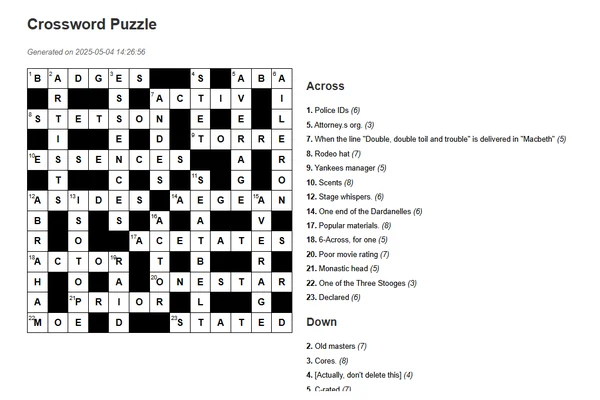
Give it a theme and it makes a New York Times–style 15×15 crossword from scratch. This scratched an itch to build my own crosswords without using expensive legacy puzzle development tools and without spending hundreds of hours per puzzle.
I’ve been building simulated populations: LLM agents serving as digital twins, each grounded in one real survey respondent. This write-up details the benchmark behind Inquire’s confidence labels. On 67 questions they never saw from the 2024 Cooperative Election Study, GPT-6 Luna agents asked for probabilities are as accurate as surveying about 36 real people on the median question, and recover Democrat–Republican gaps with r = 0.96.
Final paper for Harvard’s MBB 980. On 1,012 aligned sentence pairs, Chinese costs 1.89× the tokens of the same sentence in English under GPT-4’s tokenizer and 1.01× under Qwen 2.5’s, so much of the gap is a design choice rather than a property of the language.
This was my first attempt at solving end-to-end crossword generation with an RL environment. I used a Q-learning grid filler that optimized word scores and valid grid fills, and this personal work became my final project for my course on biological and artificial intelligence as well as the starting point for Crossword Studio.
2023Forecasting battery capacity fade.Machine-learning models that forecast how battery cell capacity fades over its lifetime, independent of individual battery chemistry, built with SandboxAQ’s Simulation and Optimization team for a commercial battery-materials client.
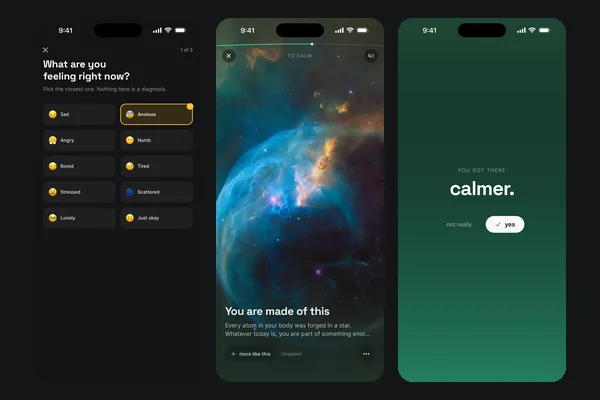
A mobile app, in private beta, that moves you from the mood you’re in toward the one you want, one card at a time. It’s an experiment in providing “Feelings as a Service” and whether an app can help people without trying to keep them on it.
2026Tournament poker, modeled.An ICM model of multi-table tournament endgames, for Harvard’s mathematical-modeling course (AM 115). I’d written poker simulations for fun before; a charity multi-table tournament got me to build this one.
2025Hackathons.I’ve built some things and brought home a little hardware. A three-judge vote on every action an agent takes, with judges of different risk tolerances, against prompt injection (CrewAI); bull, bear, and moderator agents that retrieve evidence and use multi-agent debate to inform trading decisions (AWS).
Background
2024, 2025Vatic Labs· Quantitative research. Deep-learning models for mid-frequency trading, two new strategies, and reinforcement-learning research.
2023SandboxAQ· Simulation and optimization. Machine learning for materials science and battery forecasting.
2026Harvard College· A.B., Applied Mathematics, with a focus in Economics and Computer Science.Math 55 · Stat 110 · Machine Learning · Training Foundation Models · Biological and Artificial Intelligence · Advanced Microeconomics · Game Theory · Mathematical Modeling · Applied Linear Algebra · Complex and Fourier Analysis
2022–2026Harvard Computing Society· Director for the AI group; mentored students interested in AI and ran an AI fellowship.
2022Regeneron Science Talent Search· Scholar (top 300), for a rapid saliva test for COVID-19: a lateral-flow card that detects the virus’s nucleocapsid protein by luminescence.
2021Rockefeller University· Summer research on olfaction, from brain-imaging data of mice and flies.
Elsewhere
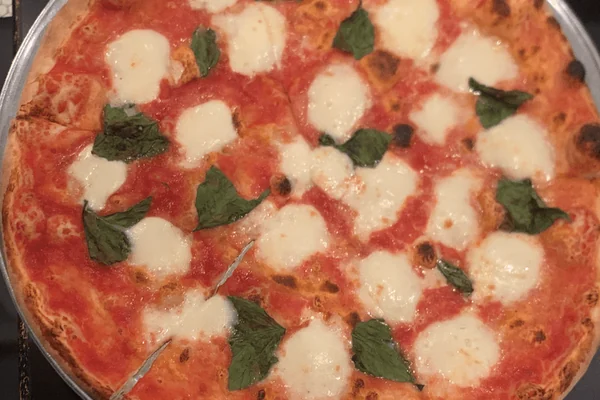
I play piano: classical, jazz (with a band), and do live pop song arrangements. When I’m not listening to music, I’m either cooking or reviewing food, sometimes on greenwichpizzareview.com and sometimes as a judge at the World Series of Barbecue. I play too much poker and love solving puzzles. I’ve wasted too many hours building computers, and keyboards like the one I’m typing this on. I’m also overly competitive at the foosball table.